miércoles, 15 de junio de 2011

Manifold: Time

Manifold: TimeManifold: Time by Stephen Baxter

My rating: 3 of 5 stars


An incredible tale that really is epic in scope. Like in his previous novel - The Time Ships - Baxter goes all out and delivers a story that spans the universe and time itself.

The story begins with the restart of the space program after NASA all but quit trying to explore space. An entrepenur called Reid Malenfant takes it upon himself to restart space exploration with the goal to reach a near Earth orbit asteroid called Cruithne with a spacecraft manned by a squid whose intelligence has been augmented via genetic tampering - and it just gets weirder from there. There's no shortage of grandiose ideas, but the problem here is that it's sometimes too much. The science needed to explain the story is very complicated and Baxter includes endless scenes where the characters are totally confused only to have the scientific goings-on explained to them in plainer language by another more brainy character. This goes on throughout ALL the book, endless explaining of what's happening instead of having the story explain itself. A tough read (this is one of those so-called Hard SF books), but I managed to get through it. This is the first novel in a trilogy but it can easily be read as a self-contained story since there is a definitive ending.


View all my reviews

jueves, 27 de enero de 2011

The Watcher in the Woods

The Watcher in the Woods

Even though I normally talk about art books in the sf-fantasy-horror genres I would like to take a time out and review a book from 1980 called The Watcher in the Woods which was the basis for the Disney film of the same name.
First, a little about the movie: The Watcher in the Woods was Disney's second PG rated film (the first being The Black Hole) and was made at a time when the studio was trying to branch out from strictly family fare into more mainstream films. One can see how the story starts out with a family feel and starts to grow from there. The film starts with a typical family, mom, dad and two daughters that are in the process of moving into an old mansion. The house is being sold by an old woman who has lived there for many years (Betty Davis). Shortly after they move in strange goings-on start to happen, usually involving mirrors, and the youngest daughter starts to enter trance like states and receive messages from beyond. From beyond where is the question the film answers.
This is one of those films that I did not see when it came out but remember clearly wanting to see it and being very intrigued by it's spooky atmosphere - which it has in spades.
The movie stays pretty close to the book of which I will now talk about. The entire book (200 plus pages) is a Young Adult novel written in the first person with the point of view of the eldest of the two daughters (played in the film by Lynn Holly Johnson of Ice Castles fame). The narrative is at times very evocative and full of atmosphere. The isolation of moving into a new home that is still heavy with the presence of a previous dweller is very much a part of the story, as is the feeling of being "watched" by something, of not belonging or intruding upon someone's life. As I said, it's a Young Adult novel, so it plays up the feelings of isolation very much.
The ending takes a turn into left field as it enters science fiction (this is more evident in the book than in the movie) leaving more than a few readers/viewers very puzzled, not by the narrative, which is spelled out quite clearly but by the tone of the story. I suppose most people, myself included, expected The Watcher in question to be a supernatural entity as we are led to believe by the book's cover.

Variations between the book and movie: SPOILERS AHEAD.
The story's main plot is the disappearance of a young girl, in the movie 30 years have passed, in the book 50 years have passed since she was last seen. This of course makes the girl's mother much older in the book than in the movie.
In the movie, an entire sub-plot is devoted to the missing girl's three friends who were present at the time of her sudden disappearance during an initiation ceremony where they would include her into their secret friendship circle. A storm toppled the edifice they were in during the ceremony, supposedly killing the girl, even though no body was ever found. They have lived with that guilt ever since. This sub-plot is entirely absent in the book.
In the book, the main protagonist sees the missing girl's image in a coffin, in the book it's in a hollowed out tree.
In the book, the girl convinces her entire family as well as the missing girl's mother about The Watcher's true nature and intentions. In the movie, she is believed only by her sister and boyfriend.
In the movie, the missing girl is returned to her mother. In the book the mother travels through space and time to her daughter in another dimension or planet (it's not made clear).

martes, 30 de noviembre de 2010

Dracula, A Symphony in Moonlight & Nightmares

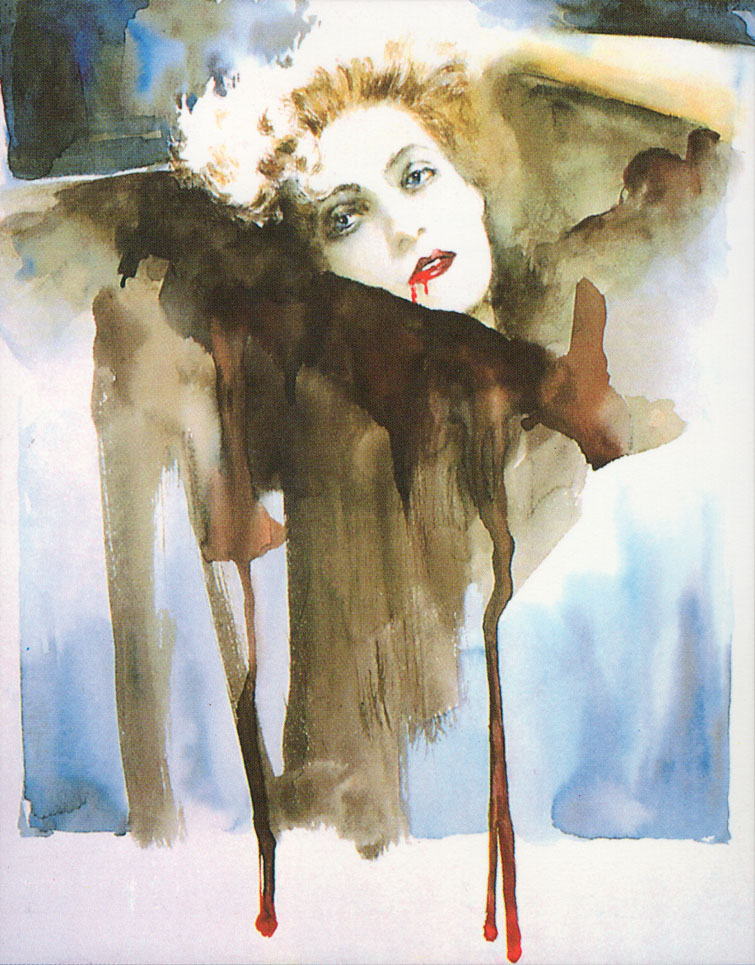
I bought this book during my "vampire" phase when I was fascinated with all things vampiric. I remember being slightly dissappointed that the illustrations leaned towards the romantic instead of the bloody but over time I've come to appreciate the subtle artistry of these exquisite watercolors. The book published in 1992 is a softcover that loosely adapts the original Bram Stoker novel and presents on every page full color watercolor illustrations by John J. Muth. None of the interior illustrations reach the level of detail and realism as that of the cover but even so are very good. I usually feature more interior scans but I fear damaging the book if I lay it on the scanner so I will only post 2 which are on the back cover and first page. I imagine that the book is long out of print but my edition is in mint condition I'm proud to say. Click for larger versions.

martes, 27 de octubre de 2009

Esteban Maroto - Wonders

Esteban Maroto is an artist that, like José González and Gonzalo Mayo was familiar to readers of Warren magazines where he displayed his particular talent for combining beautiful women with hideous creatures. His style was always very fluid and sensuous and always very European as he drew in a relistic manner and not in the cartoony style of many American artists. He also did some work for DC Comics like the four issue Zatanna mini-series of the 90's, but I digress.
This book is a very good display of his work, at 64 pages it's not by any means a comprehensive view of the artist's work but a good overview. Sadly, no work from his Warren days is included so all of the work is of the pinup variety where we get a single illustration per page unrelated to any characters or stories. But what art! Maroto is a true master of form and his women are legendarily beautiful and exotic. In fact the back cover states that the book is "Adults only" and indeed, almost ALL of the pieces feature nudity (a good thing, I always say).
The artwork is divided by theme into 6 sections, Vampires, Fantasy, Woman & Woman, Monsters & Demons, Nymphs and finally Light & Color, where we are trated to a collection of 14 gorgeous color pieces where Maroto shows he can paint with the best of them. The beginning of each chapter has a small introduction which is presented in three languages, Spanish, English and German. I bought this book on Amazon a couple of years ago, but sadly it is no longer in print and can only be found used at a very steep price.
Below are examples from each of the book's sections. Click for a bigger size. Enjoy!

martes, 15 de septiembre de 2009

Sorceress, The Mike Hoffman Sketchbook Volume 1

When one talks about influences in someones artwork, it’s always a tricky thing. Is the artist paying homage, or simply ripping off another artist? Does his style originate from another or is he copying? I wanted to mention this right off the bat because Mike Hoffman is often accused of being a Frank Frazetta clone, and looking at his artwork one would be inclined to agree. The influence is more than obvious, not just the subject matter, but the artistic style itself. In fact, if you look up the book on Amazon.com you will find mostly negative reviews that slam the book because of its lack of originality. However, I will let you decide if this lessens the artwork or not and just focus on what the book offers and let the art stand on its own.

This book was published in 1999 by SQP Publishing and is the first of 2 volumes called Sorceress, and one of many Hoffman artbooks available. The entire book is comprised of black and white pencil drawings, (no inks) and only the cover presents a full color painting. The subject matter is sword and sorcery with a heavy dose of jungle girls and prehistoric scenes. Like the title implies, the book is mostly devoted to the female form, though there are a few drawings without women, the bulk of the art features Frazetta-like women who are for the most part topless or completely nude. Hoffman likes his busty girls, that’s for sure (and who doesn’t?).

I have to say that I myself like Hoffman’s style, it’s clean and uncluttered with a very good sense of form. His tonework is subtle and doesn’t “gray out” his figures with too much shading, letting the linework take center stage. His depiction of women is idealized to be sure, as it is with most fantasy artists, but he never goes overboard and his figures always retain a sense of reality that grounds his work and gives it more power. Another thing I like is that, besides Frazetta, Hoffman seems to be influenced by the Warren magazines of the 70’s, which gives his art a retro feel that I just love.

martes, 18 de agosto de 2009

Sanjulian

It wasn't long ago that I reviewed another Sanjulian art book by Big Wow books, well they have published another one and it is marginally better than the first one but still sorely lacking becaus of its size. Again the format is a 5.5 inches wide by 8.5 inches tall, an insult to Sanjulian's work as the paintings should be seen in at least full letter size or more to better appreciate the art. But enough griping. The book presents both color and black and white pieces, this time in full page format (unlike the other book which placed a useless frame around the art) so one has a slightly bigger view of the art. Even though the artist is best known for his covers of Warren comics, none are presented here, though several o the pieces could have been Creepy or Eerie covers. In regards to the subject matter, Sanjulian leans a bit more to the mainstream side with the inlcusion of well known characters. Some seem to be comissioned works like the drawings of Padme Amidala from Star Wars and 2 of Catwoman. And check out the Jonah Hex piece with a topless babe! I doubt DC Comics would have used that on their comics. In total 12 color pices and 13 black and white drawings, including a self-portrait. Also if you order it from Bud's Art Books it will come signed by the master himself. Click for bigger sizes.

lunes, 29 de junio de 2009

Modern Masters Vol. 12: Michael Golden

Michael Golden is a name familiar to those of us who have been reading comics since the 70's and 80's. His style sometimes leans towards the cartoony but never really crosses the line into being "funnybook" style. His line always conveys a sense of fluidity and vitality that is sadly lacking in many artists.
Upon reading this book, which like many of the "Modern Masters" series, is really one long interview with the artist, one realizes that Golden kind of fell into comics and was never really confortable in the field, leaving it alltogether for long stretches to pursue illustrative work in advertising only to come back to comics whenever some editor called him for a project, and only then, if Golden had the time for it. He admits to having no real love for comics as a child and explains his almost accidental entrance into the field at the insistance of a friend.
This is one thing that comes across in many interviews with comic or fantasy artists which are revered by fans. The fact that to them their work is just that - work, a job, not some dream assignment. This is a hard pill to swallow for many fans as they believe that their favorite artists and writers are as emotionally invested in their work as the fans themselves. Golden admits that him drawing Batman or Spiderman or any other high profile character was nothing special, just a job to be done. The interviewer tries to goad the artist into saying if he was excited or felt anything special when drawing the caped crusader instead of the lesser character The Demon, but Michael Golden says simply "No". Nuff said.
The interview itself is very well done and Golden spills the beans on many interesting behind the scenes goings on at both DC and Marvel, nothing scandalous, mind you, just cool insider stuff that gives readers a further appreciation for how a comic comes together.
Of course, the best part of the book is the art, even though there is plenty of text, there are examples of Golden's work on every page with many full page reproductions. An extensive gallery section at the end of the book rounds things off nicely with some color illustrations included. Most of the book is in black and white, but don't let that deter you as Golden's work is better appreciated that way. In closing, a worthy addition to the Modern Masters series.