- The Shining
- The Stand, comic book adaptation Vol. 1 - Captain Trips
- Under the Dome
- The Colorado Kid

viernes, 11 de noviembre de 2011
2011 Stephen King Challenge update.
Read so far (November 11), four! And I'm kind of cheating since I'm counting The Stand, Vol. 1 in comic book form which is not the whole novel but does include the first five issues of the series,


martes, 11 de octubre de 2011

lunes, 29 de agosto de 2011
My love-hate-love relationship with Stephen King

Stephen King was the first "name" author that I started reading. Before him I would just pick up books because I thought the premise was intriguing or I really loved the cover - or both.
During my teens I became obsessed with the horror genre. I was a regular reader of Fangoria magazine and I would watch as many horror movies as I could - good or bad - I was an easy to please viewer. When I started reading books, King was the obvious choice since I had already seen many of the film adaptations. But his books did not go down easy with the teenage me, they were WAY too long and I often either didn't finish them or gave up altogether. Such was the case with The Dead Zone, which I stopped reading three quarters of the way through and with It and The Stand where I skimmed the last part of the books since I was just tired of reading.
My frustration grew so much that I made a solemn vow - I will NEVER AGAIN read a book over 500 pages in length. I figured any author worth his salt could tell a story, even an "epic" one, in less than 500 pages.
And so it went for a few years, I swore off King's massive volumes and concentrated on shorter, more concise tales. But as I got older, I reconsidered, and decided to give the master of horror another shot. I read Insomnia, Salem's Lot and some of the short story collections like Skeleton Crew and my interest was rekindled. Now as an older reader, long novels didn't scare me off and I had the patience to see them through. I started to see where King was coming from as a writer and what he wanted to achieve with the reader. His are character driven stories (like From A Buick 8 pictured above) that take their time to sink in, but when they do the reader is richly rewarded. I still think his novels are too long but I'm willing to trust him in that he knows how long his novels need to be. I'm now tackling the massive Under the Dome (1000 plus pages!) and I'm in it for the long haul.
miércoles, 10 de agosto de 2011
The 2011 Stephen King Challenge!

I just found out about this challenge from Book Chick City and though I've read a LOT of King over the years, I still have many books of his that I haven't read. Since I just finished The Shining (shame on me for putting it off for so long) and plan on reading Full Dark, No Stars as well as diving into The Dark Tower series, I though I'd participate.
Read so far (August 10), only one! - The Shining, and have started re-reading the short story collection Skeleton Crew.
On the to-read list:
- The Stand comic book adaptation trade paperbacks, starting with Captain Trips which are issues 1-5 of the series. Have already ordered it online and am awaiting its arrival.
- Under the Dome - Have heard many good things about this one.
- Full Dark, No Stars now that its out in paperback.
- The Dark Tower series - I read the first two books a long time ago and then just never got back to the series. I plan to buy the revised edition of The Gunslinger and see if I can at least finish the next three books in the series by the end of the year.
- American Vampire - a comic book series only partially written by King, but I think its still counts.
- 11/22/63 - The premise is so interesting that I'll buy the hardcover version instead of waiting for the paperback as I usually do.
- Mile 81 - I plan to buy en e-reader this year and this will be my first ebook purchase.
Will I be able to finish this list? Probably not, in fact I know I won't, but I'll have a lot of fun trying!
jueves, 21 de julio de 2011
Reading Habits Meme
Do you snack while you read? If so, favourite reading snack:
I don't snack while I read.
Do you tend to mark your books as you read, or does the idea of writing in books horrify you?
I never write in books or highlight them.
How do you keep your place while reading a book? Bookmark? Dog-ears? Laying the book flat open?
I use a trading card as a bookmark. I never "dog-ear".
Fiction, non-fiction, or both?
Both, though much more fiction.
Are you a person who tends to read to the end of a chapter, or can you stop anywhere?
I always try to read to the end of a chapter.
Are you the type of person to throw a book across the room or on the floor if the author irritates you?
No.
If you come across an unfamiliar word, do you stop and look it up right away?
No, I keep reading.
What are you currently reading?
The Red Tree by Caitlin Kiernan.
What is the last book you bought?
DC Comics: 75 Years of Modern Mythmaking.
Are you the type of person that reads one book at a time, or can you read more than one?
One at a time.
Do you have a favourite time/place to read?
During the morning before going to work and during my lunch break.
Do you prefer series books or stand alones?
Stand alones.
Is there a specific book or author you find yourself recommending over and over?
Author: Dan Simmons. Book: Dune.
How do you organize your books?
I don't. I try to keep them as tidy as possible by placing them by size.
miércoles, 15 de junio de 2011
Manifold: Time
 Manifold: Time by Stephen Baxter
My rating: 3 of 5 stars
An incredible tale that really is epic in scope. Like in his previous novel - The Time Ships - Baxter goes all out and delivers a story that spans the universe and time itself.
The story begins with the restart of the space program after NASA all but quit trying to explore space. An entrepenur called Reid Malenfant takes it upon himself to restart space exploration with the goal to reach a near Earth orbit asteroid called Cruithne with a spacecraft manned by a squid whose intelligence has been augmented via genetic tampering - and it just gets weirder from there. There's no shortage of grandiose ideas, but the problem here is that it's sometimes too much. The science needed to explain the story is very complicated and Baxter includes endless scenes where the characters are totally confused only to have the scientific goings-on explained to them in plainer language by another more brainy character. This goes on throughout ALL the book, endless explaining of what's happening instead of having the story explain itself. A tough read (this is one of those so-called Hard SF books), but I managed to get through it. This is the first novel in a trilogy but it can easily be read as a self-contained story since there is a definitive ending.
View all my reviews
jueves, 27 de enero de 2011
The Watcher in the Woods

Even though I normally talk about art books in the sf-fantasy-horror genres I would like to take a time out and review a book from 1980 called The Watcher in the Woods which was the basis for the Disney film of the same name.
First, a little about the movie: The Watcher in the Woods was Disney's second PG rated film (the first being The Black Hole) and was made at a time when the studio was trying to branch out from strictly family fare into more mainstream films. One can see how the story starts out with a family feel and starts to grow from there. The film starts with a typical family, mom, dad and two daughters that are in the process of moving into an old mansion. The house is being sold by an old woman who has lived there for many years (Betty Davis). Shortly after they move in strange goings-on start to happen, usually involving mirrors, and the youngest daughter starts to enter trance like states and receive messages from beyond. From beyond where is the question the film answers.
This is one of those films that I did not see when it came out but remember clearly wanting to see it and being very intrigued by it's spooky atmosphere - which it has in spades.
The movie stays pretty close to the book of which I will now talk about. The entire book (200 plus pages) is a Young Adult novel written in the first person with the point of view of the eldest of the two daughters (played in the film by Lynn Holly Johnson of Ice Castles fame). The narrative is at times very evocative and full of atmosphere. The isolation of moving into a new home that is still heavy with the presence of a previous dweller is very much a part of the story, as is the feeling of being "watched" by something, of not belonging or intruding upon someone's life. As I said, it's a Young Adult novel, so it plays up the feelings of isolation very much.
The ending takes a turn into left field as it enters science fiction (this is more evident in the book than in the movie) leaving more than a few readers/viewers very puzzled, not by the narrative, which is spelled out quite clearly but by the tone of the story. I suppose most people, myself included, expected The Watcher in question to be a supernatural entity as we are led to believe by the book's cover.
Variations between the book and movie: SPOILERS AHEAD.
The story's main plot is the disappearance of a young girl, in the movie 30 years have passed, in the book 50 years have passed since she was last seen. This of course makes the girl's mother much older in the book than in the movie.
In the movie, an entire sub-plot is devoted to the missing girl's three friends who were present at the time of her sudden disappearance during an initiation ceremony where they would include her into their secret friendship circle. A storm toppled the edifice they were in during the ceremony, supposedly killing the girl, even though no body was ever found. They have lived with that guilt ever since. This sub-plot is entirely absent in the book.
In the book, the main protagonist sees the missing girl's image in a coffin, in the book it's in a hollowed out tree.
In the book, the girl convinces her entire family as well as the missing girl's mother about The Watcher's true nature and intentions. In the movie, she is believed only by her sister and boyfriend.
In the movie, the missing girl is returned to her mother. In the book the mother travels through space and time to her daughter in another dimension or planet (it's not made clear).
martes, 30 de noviembre de 2010
Dracula, A Symphony in Moonlight & Nightmares
 I bought this book during my "vampire" phase when I was fascinated with all things vampiric. I remember being slightly dissappointed that the illustrations leaned towards the romantic instead of the bloody but over time I've come to appreciate the subtle artistry of these exquisite watercolors. The book published in 1992 is a softcover that loosely adapts the original Bram Stoker novel and presents on every page full color watercolor illustrations by John J. Muth. None of the interior illustrations reach the level of detail and realism as that of the cover but even so are very good. I usually feature more interior scans but I fear damaging the book if I lay it on the scanner so I will only post 2 which are on the back cover and first page. I imagine that the book is long out of print but my edition is in mint condition I'm proud to say. Click for larger versions.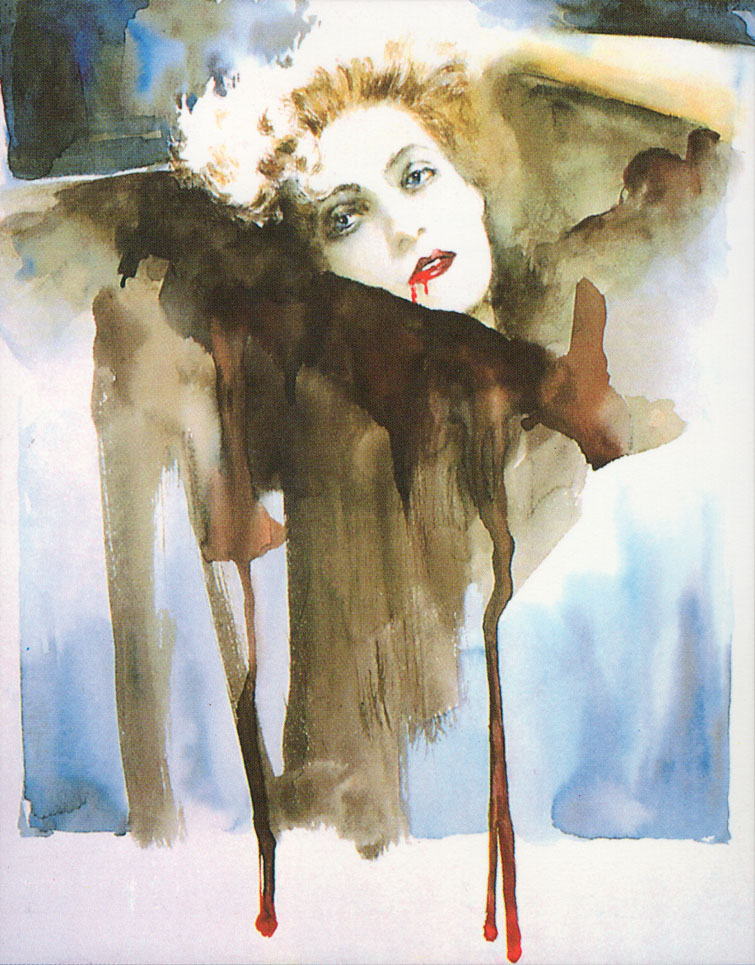

martes, 27 de octubre de 2009
Esteban Maroto - Wonders
 Esteban Maroto is an artist that, like José González and Gonzalo Mayo was familiar to readers of Warren magazines where he displayed his particular talent for combining beautiful women with hideous creatures. His style was always very fluid and sensuous and always very European as he drew in a relistic manner and not in the cartoony style of many American artists. He also did some work for DC Comics like the four issue Zatanna mini-series of the 90's, but I digress.
This book is a very good display of his work, at 64 pages it's not by any means a comprehensive view of the artist's work but a good overview. Sadly, no work from his Warren days is included so all of the work is of the pinup variety where we get a single illustration per page unrelated to any characters or stories. But what art! Maroto is a true master of form and his women are legendarily beautiful and exotic. In fact the back cover states that the book is "Adults only" and indeed, almost ALL of the pieces feature nudity (a good thing, I always say).
The artwork is divided by theme into 6 sections, Vampires, Fantasy, Woman & Woman, Monsters & Demons, Nymphs and finally Light & Color, where we are trated to a collection of 14 gorgeous color pieces where Maroto shows he can paint with the best of them. The beginning of each chapter has a small introduction which is presented in three languages, Spanish, English and German. I bought this book on Amazon a couple of years ago, but sadly it is no longer in print and can only be found used at a very steep price.
Below are examples from each of the book's sections. Click for a bigger size. Enjoy!


martes, 15 de septiembre de 2009
Sorceress, The Mike Hoffman Sketchbook Volume 1
 When one talks about influences in someones artwork, it’s always a tricky thing. Is the artist paying homage, or simply ripping off another artist? Does his style originate from another or is he copying? I wanted to mention this right off the bat because Mike Hoffman is often accused of being a Frank Frazetta clone, and looking at his artwork one would be inclined to agree. The influence is more than obvious, not just the subject matter, but the artistic style itself. In fact, if you look up the book on Amazon.com you will find mostly negative reviews that slam the book because of its lack of originality. However, I will let you decide if this lessens the artwork or not and just focus on what the book offers and let the art stand on its own.
 This book was published in 1999 by SQP Publishing and is the first of 2 volumes called Sorceress, and one of many Hoffman artbooks available. The entire book is comprised of black and white pencil drawings, (no inks) and only the cover presents a full color painting. The subject matter is sword and sorcery with a heavy dose of jungle girls and prehistoric scenes. Like the title implies, the book is mostly devoted to the female form, though there are a few drawings without women, the bulk of the art features Frazetta-like women who are for the most part topless or completely nude. Hoffman likes his busty girls, that’s for sure (and who doesn’t?).
 I have to say that I myself like Hoffman’s style, it’s clean and uncluttered with a very good sense of form. His tonework is subtle and doesn’t “gray out” his figures with too much shading, letting the linework take center stage. His depiction of women is idealized to be sure, as it is with most fantasy artists, but he never goes overboard and his figures always retain a sense of reality that grounds his work and gives it more power. Another thing I like is that, besides Frazetta, Hoffman seems to be influenced by the Warren magazines of the 70’s, which gives his art a retro feel that I just love.
martes, 18 de agosto de 2009
Sanjulian
 It wasn't long ago that I reviewed another Sanjulian art book by Big Wow books, well they have published another one and it is marginally better than the first one but still sorely lacking becaus of its size. Again the format is a 5.5 inches wide by 8.5 inches tall, an insult to Sanjulian's work as the paintings should be seen in at least full letter size or more to better appreciate the art. But enough griping. The book presents both color and black and white pieces, this time in full page format (unlike the other book which placed a useless frame around the art) so one has a slightly bigger view of the art. Even though the artist is best known for his covers of Warren comics, none are presented here, though several o the pieces could have been Creepy or Eerie covers.
  In regards to the subject matter, Sanjulian leans a bit more to the mainstream side with the inlcusion of well known characters. Some seem to be comissioned works like the drawings of Padme Amidala from Star Wars and 2 of Catwoman. And check out the Jonah Hex piece with a topless babe! I doubt DC Comics would have used that on their comics. In total 12 color pices and 13 black and white drawings, including a self-portrait. Also if you order it from Bud's Art Books it will come signed by the master himself. Click for bigger sizes.
lunes, 29 de junio de 2009
Modern Masters Vol. 12: Michael Golden
 Michael Golden is a name familiar to those of us who have been reading comics since the 70's and 80's. His style sometimes leans towards the cartoony but never really crosses the line into being "funnybook" style. His line always conveys a sense of fluidity and vitality that is sadly lacking in many artists.
Upon reading this book, which like many of the "Modern Masters" series, is really one long interview with the artist, one realizes that Golden kind of fell into comics and was never really confortable in the field, leaving it alltogether for long stretches to pursue illustrative work in advertising only to come back to comics whenever some editor called him for a project, and only then, if Golden had the time for it. He admits to having no real love for comics as a child and explains his almost accidental entrance into the field at the insistance of a friend.

This is one thing that comes across in many interviews with comic or fantasy artists which are revered by fans. The fact that to them their work is just that - work, a job, not some dream assignment. This is a hard pill to swallow for many fans as they believe that their favorite artists and writers are as emotionally invested in their work as the fans themselves. Golden admits that him drawing Batman or Spiderman or any other high profile character was nothing special, just a job to be done. The interviewer tries to goad the artist into saying if he was excited or felt anything special when drawing the caped crusader instead of the lesser character The Demon, but Michael Golden says simply "No". Nuff said.
The interview itself is very well done and Golden spills the beans on many interesting behind the scenes goings on at both DC and Marvel, nothing scandalous, mind you, just cool insider stuff that gives readers a further appreciation for how a comic comes together.

Of course, the best part of the book is the art, even though there is plenty of text, there are examples of Golden's work on every page with many full page reproductions. An extensive gallery section at the end of the book rounds things off nicely with some color illustrations included. Most of the book is in black and white, but don't let that deter you as Golden's work is better appreciated that way. In closing, a worthy addition to the Modern Masters series.
miércoles, 27 de mayo de 2009
Sanjulian - art book
 Manuel Pérez Clemente, better known by his artistic name of Sanjulian, is known by most for his incredible covers of Warren comics in the 1970's, and like José González, was one of many latin artists employed by Warren at the time. His covers for Vampirella were his most famous and have become almost iconic. Unfortunately none of these covers are reproduced here. Equally unfortunate is that the format of this small book is woefully inadequate to appreciate the work of this great master of the fantastic. The book, almost a pamphlet really, is barely 8.5 inches tall by 5.5 inches wide. The good news is that it's full color throughout (except for the black and white drawings, of course) and it's printed on heavy stock.
But enough complaining, let's see what we do get. 32 pages, 23 color pieces and 10 black and white drawings from a very wide variety of themes. From the usual sword and sorcery to comic book pinups and even some Star Wars. As far as I know, Sanjulian was never an interior comic artist so the drawings included are probably commission pieces. Vampirella fans will be glad to know that she is represented with two excelent drawings,both of which I have scanned and present here, click for larger versions.


 The rest of the art shows Sanjulian's work from various book covers and some advertising work. I can only assume that is the case because there is no text at all that tells us anything about the art. Not a caption, nothing. What's worse is that most of the art is not presented in full page format but instead has a rather large colored border around it making the art smaller than the already small format of the book. I have presented the scans without the useless border here of course, as it should be. Why they chose to do this is beyond me. Big Wow publishing, who published this book, really dropped the ball here. I'm still waiting for a large format hardcover edition of Sanjulian's work like the previously reviewed Art of Jeffrey Jones, that will really do justice to this amazing and underappreciated artist. An edition which showcases his Warren covers as well as his more personal works. We'll have to wait and see if any publisher is up to the task. There are a couple of other Sanjulian artbooks which I will review later on, but these are also not up to the standard that this artist deserves.
lunes, 18 de mayo de 2009
Femmes de Rêve - José González
 This long out of print French publication from 1978 is, I believe, the ONLY compilation of the late great José González's work, and please somebody correct me if I'm wrong since I would love to know that there is another book out there.
José "Pepe" González, as many of you may know, sadly passed away earlier this year (2009) at the age of 70. He is best known by comic book fans as one of the best (or THE best in my opinion) artists for Warren's Vampirella comic magazine that was published during the late 60's, all through the 70's and the early 80's. José's knack for drawing beautiful women came in handy while drawing the scantily clad Vampirella but always with a touch of class that is sadly lacking in many of today's hack artists who couldn't draw a well proportioned woman if they're life depended on it, but I digress.
Femmes de Rêve (Dream Women) is not by any means a definite overview of the spanish artist, but it does a good job of giving us a bit of everything that was the art of José González. It starts with 4 page "Women in Jail" story with a SF twist at the end called Trop, C'est Assez which may or may not be a reprint from a Warren comics story (it has a certain 1984-ish feel to it, though it may be from Creepy, Eerie or even a backup story from Vampirella comics).
 It continues with a series of sexy/humorous one panel drawings with pretty girls and then a Warren Vampirella reprint - Rêve Attristant (Sad Dream), the whole 10 page story where we see José at the top of his game - great stuff. Then a portfolio section with an interesting cross section of art from various genres.
The next full story is the longest in the book - Herma a full length color comic where the titular character, Herma, gets herself into a series of situations where she frequently has to disrobe. In fact there are naked ladies in just about every page of this story. I've never heard of this comic or this character, but like most of this book it probably appeared originally somewhere else. Here's a panel from the story:
 The book ends in a grand fashion with the absolutely stunning 6 page romance tale Au-Delà de l'Aube (Beyond the Dawn), a black and white story with the some of the best art I've seen from José. The story is incredibly simple but that's not important, the thing here is the mood that the artist creates with his drawings. José González inking style is one that I've always admired, and I'm almost certain that he ALWAYS inked his own stuff. His incredibly controlled, yet fluid line and his mastery of light and shadow is something to behold. Feast your eyes on the splash page and an interior page and see why José González is a legend, click for larger versions.

If you want to read a very interesting article about José González's Vampirella art, check out these links at the excellent Groovy Age of Horror blog here and here.
jueves, 30 de abril de 2009
The Art of Jeffrey Jones
 Jeff Jones is an artist that I wasn't too familiar with but I became curious about his work when I saw the amount of really cool paperback covers that the he had painted in the late 60's and early 70's (check many of them out at the excellent Groovy Age of Horror blog). This hardcover coffe table sized book is the first collection of his work in such a format. His stuff had previously been only available in limited edition prints or portfolios. At first, one may dismiss Jones as one of the many Frazetta clones out there, mostly in his very early work where the influence is most obvious, but closer inspection reveals that he has a style and visual language all his own.
Jeff Jones started as a commercal artist doing covers for sf, fantasy and horror paperbacks and in the book he minces no words when he says that he plain didn't like it. Jeff Jones is an artiste, you see, who scorns anything that comes between him and his vision. OK, maybe I'm being bit sarcastic in describing Mr Jones, but it's true that he always felt uncomfortable in doing work for others, prefering instead his personal projects, many of which are loosely fantasy based, by this I mean they touch upon the mythic, likes visions of ancient warriors, prehistoric vistas and jungle heroes who may or may not be Tarzan.

In closing, this is really a very well put together book that showcases Jones' work with great full page high quality reproductions. By no means a complete catalog of his art, but an excellent overview.
sábado, 18 de abril de 2009
Draw Comics With Dick Giordano

There are many "how to draw comics" out there, and I admit that the main reason I bought this one was because it's by comics legend Dick Giordano who has been associated with DC comics for most of his career. It's a shame that absolutley NO DC ART is featured in the book, probably because of copyright issues. It seems to me that DC should have cut Dick some slack and let him use samples of his own work using DC characters. On the plus side, it means that almost all the great art featured is previously unpublished work drawn by Dick for this book.
The book is aimed, not on those who want to learn how to draw, but those that want to learn how to draw comics, and in this Dick goes into great detail and gives you his tips and tricks from decades of experience.
His chapter on inking, called "The Art of Inking, is one of the best studies done of this dissapearing and misunderstood part of comic art. Indeed, Dick is mainly known as one of the best inkers in the business, having inked many comic classics and over the pencils of Great Ones like Neal Adams, Geore Pérez, Jose Luis García López and many others.
His (grossly underrated) pencilling is fantastic also, reminiscent of the aforementioned Neal Adams and García López but with a unique clean classic style all his own.
The sections on figure drawing offer many examples of different body and character types, showing that comic book drawing is not all super heroes. I do wish he would have gone into greater detail on the anatomy of the human figure since he hardly discusses muscle groups or skeletal structure, in this respect, a certain degree of previous drawing experience is a must.
Lastly, the sections on visual storytelleing and composition round things out quite nicely, and I daresay many of todays comic artists could benefit from the advice given in this chapter. There's even a part where Dick gives aspiring artists real advice on how to presents your portfolio and try to break into the businness, beyond the usual "practice, practice, practice".
If you don't know how to draw at all, this book may not be for you, though you will surely learn from it. If you're someone interested in drawing comics, this is invaluable and even as a Dick Giordano sketchbook it is a great example of one of the modern master of comic art.
miércoles, 11 de febrero de 2009
The Art of Rudy Nebres

In case you haven't heard of him, Rudy Nebres is one of the many Filipino artists that were employed in the American Comics industry during the 60's and 70's. I came to know him from his work in Warren's Vampirella and was immediately drawn to his fluid and expressive line and mastery of the "feathered brush" inking technique.
This book is not an overview of his work in Warren, Marvel or DC, but rather a collection of black and white pinups that showcase his unique style. Some are pencil drawings while others are inked with only the cover and back cover having color. This is really not that bad since Rudy's art works better in black and white. The subject matter is mainly fantasy with many drawings of Conan, Red Sonja, Tarzan and a variety of scantily clad women with a bit of nudity here and there, but not much.
jueves, 3 de julio de 2008
Modern Masters Vol. 5: José Luis García López

 I just finished reading the book Modern Masters Vol. 5: J.L. García López which is basically one long interview with the legendary artist where he talks of his carrer as a comic book artist in Argentina and at DC Comics - highly reccomended.
Anyway, when he talks of superhero comics he's not exactly too excited and admits he was "uncomfortable" with the genre (!). This coming from the man who's sinonimous with DC Comics heroes and who literally defined the way they looked with the fabled DC Style Guides (man, I wish I had one of those).
But which title does he remember most fondly? DC Comics Presents? Batman? No, its: Atari Force.
Go figure.
But for those of us who consider García-López one of the best if not THE best comic book artist ever (at least at DC) this colume is invaluable. As far as I know this is the ONLY collection of work by García-López, get it while you can.
Go figure.
But for those of us who consider García-López one of the best if not THE best comic book artist ever (at least at DC) this colume is invaluable. As far as I know this is the ONLY collection of work by García-López, get it while you can.
miércoles, 11 de junio de 2008
The Art of Arantza
 There are scores of artists working in the field of erotic fantasy but Arantza (a woman by the way) stands head and shoulders above most of the hacks by infusing her drawings of beautiful women with life. Here is an artist that knows how to draw and knows what a woman actually looks like. This may seem like a redundant statement, but believe me, it's not. Most artists working today have little or no sense of proportion, anatomy or composition. I will not name names, but they know who they are. By using pencil tones and a brilliant use of light/dark these drawings come off almost as paintings since these are not just a collection of sketches but fully realised works. Normally I don't include images from the interior artwork of a book, but here I'll make an exception so you can see what I mean.
 The Illustrations lean heavily towards the dark erotic fantasy with many drawings of nude or scantily clad vampires, witches and gothic locales.
To me, Arantza follows in the same tradition as other Spanish artists like José González, Sanjulián, Esteban Maroto, Fernando Fernandez and Enrich, all of whom were true masters of the medium. Get this one while it's still in print!
Mark Schultz: Various Drawings Vol. 1
 I first became aware of Mark Schultz with a couple of Cadillacs and Dinosaurs graphic novels I bought in the 90's and was immediatly impressed with his old-school style reminiscent of Frazetta and Alex Raymond, especially in the inks. Schultz often uses an inking technique called dry brush which really lift the drawings to another level by giving them more depth and tonal variety. Included are many character sketches from Cadillacs and Dinosaurs as well as some Conan pieces and various other works. It's all in black and white but believe me, it's much better this way since one can better appreciate Schultz' skill and beautiful fluid inking. Great stuff!
Suscribirse a:
Entradas (Atom)